

Investor Insight: Diversification at Work in Uncertain Markets
April 2026 Client Letter from Savant Wealth Management
In late March, the Dow Jones Industrial Average officially entered correction territory—defined as a decline of 10% or more from its peak—amid renewed geopolitical tensions and growing concerns about the global economy. While headlines like these can understandably create unease, they don’t always tell the full story.
It may come as a surprise that well-diversified portfolios have likely held up much better than the Dow during periods of market volatility. The reason is simple: the Dow represents just 30 large U.S. companies—names like Walmart, Coca-Cola, and Apple. While it’s one of the most widely followed indicators of “the market,” it reflects only a narrow slice of the broader investment landscape.
Even the S&P 500, though more expansive, remains heavily weighted toward large-cap U.S. stocks. As a result, it can sometimes mask how other areas of the market are performing.
Recent market dynamics have highlighted the value of diversification. Asset classes such as small-cap value stocks and U.S. REITs have, at times, behaved differently than large-cap equities—helping to cushion portfolios when more concentrated indices experience declines.
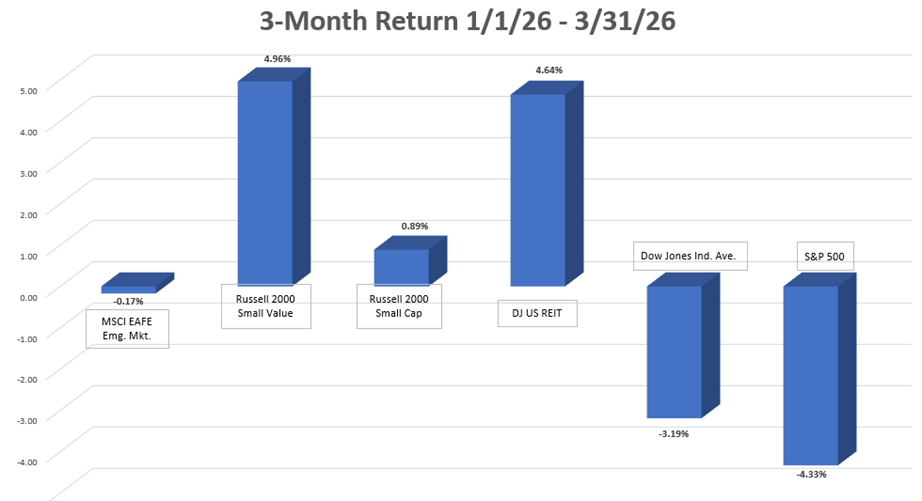
One advantage of the institutional, asset-class funds used in Savant’s portfolio strategies is their ability to diversify beyond the narrow segments represented by indices like the Dow. While this broader exposure may not always stand out when large-cap stocks dominate headlines, over time it can play a critical role in helping manage risk and enhance long-term outcomes.
There is a reason large institutional investors, such as pension funds and endowments, anchor their decisions in clearly defined Investment Policy Statements (IPS). These frameworks serve as the foundation of their investment process, helping to guide decisions and limit the influence of short-term emotions.
Market environments can stir powerful reactions. During periods of volatility—like those seen in 2001, 2008, and 2020—fear can drive investors toward reactive decisions. On the other hand, prolonged market optimism, like the late 1990s or mid-2000s, can create a sense of overconfidence or “irrational exuberance.”
In both cases, emotion can lead investors away from sound decision-making.
By establishing a disciplined strategy through an IPS, institutional investors create guardrails that help them stay focused on long-term goals rather than short-term noise. Importantly, these structures also hold investment advisors accountable to a consistent process.
This same principle is why Savant develops Investment Policy Statements for its clients. In times of uncertainty—politically, economically, and emotionally—an IPS serves as a steady guide, helping both advisor and client remain aligned and thoughtful in their approach.
In a recent interview, Warren Buffett offered one of his characteristically insightful observations on the idea that someone might possess a secret investment strategy capable of delivering outsized returns with little risk—and then freely share it.
“The idea that if they had gold in their backyard, they’d come on television and say, ‘here’s where the gold is in my backyard…’” Buffett remarked.
His point reinforces a fundamental truth: there is no way around the relationship between risk and return. Investments promising unusually high rewards are almost always accompanied by equally elevated risk.
Consider the logic—if someone truly had a strategy that consistently produced exceptional returns without downside, there would be little reason to share or sell it. The continued presence of such claims in financial media suggests not that they are valid, but that the desire for a “free lunch” remains strong.
If you encounter claims of above-market returns with below-market risk, it’s wise to approach them with caution.
Historical performance results for investment indices, benchmarks, and/or categories have been provided for general informational/comparison purposes only, and generally do not reflect the deduction of transaction and/or custodial charges, the deduction of an investment management fee, nor the impact of taxes, the incurrence of which would have the effect of decreasing historical performance results. It should not be assumed that your account holdings correspond directly to any comparative indices or categories.
Ready to Talk About Your Financial Strategy?
Periods of volatility can create uncertainty, but they also offer an opportunity to revisit your long‑term goals and ensure your plan remains aligned with your needs. If you’d like to discuss how these market insights apply to your personal financial situation, or if you’re considering adjustments to your investment strategy, our team is here to help.
HTB Wealth Advisors partners with clients to build evidence‑based, disciplined wealth plans designed to weather market shifts and support long‑term success.
Ready to take the next step? Start with a no-cost investment assessment. It’s an easy way to review your current portfolio, identify opportunities, and see how personalized planning can help you achieve your goals.