

Investor Insight: Why Diversification Still Matters
July 2026 Client Letter from Savant Wealth Management
“Diversification is dead.”
We have lost count of the number of times we’ve heard that assertion from active managers in the past three decades. When large cap U.S. stocks lead the market for an extended period, diversification can, indeed, seem like a fool’s errand. Just buy the S&P 500 and be done with it, the conventional wisdom goes. But investors who just buy the S&P 500 index are still in a concentrated portfolio even though they may have exposure to hundreds of different stocks within that index. Stocks within an asset class are highly correlated, meaning they tend to rise and fall together.
That’s why a well-diversified portfolio includes exposure to a wide variety of asset classes beyond U.S. large cap, including both U.S. and international small cap stocks, and emerging markets. Looking at the performance of those asset classes recently, we can observe periods where diversification has provided relative benefits beyond U.S. large cap stocks:
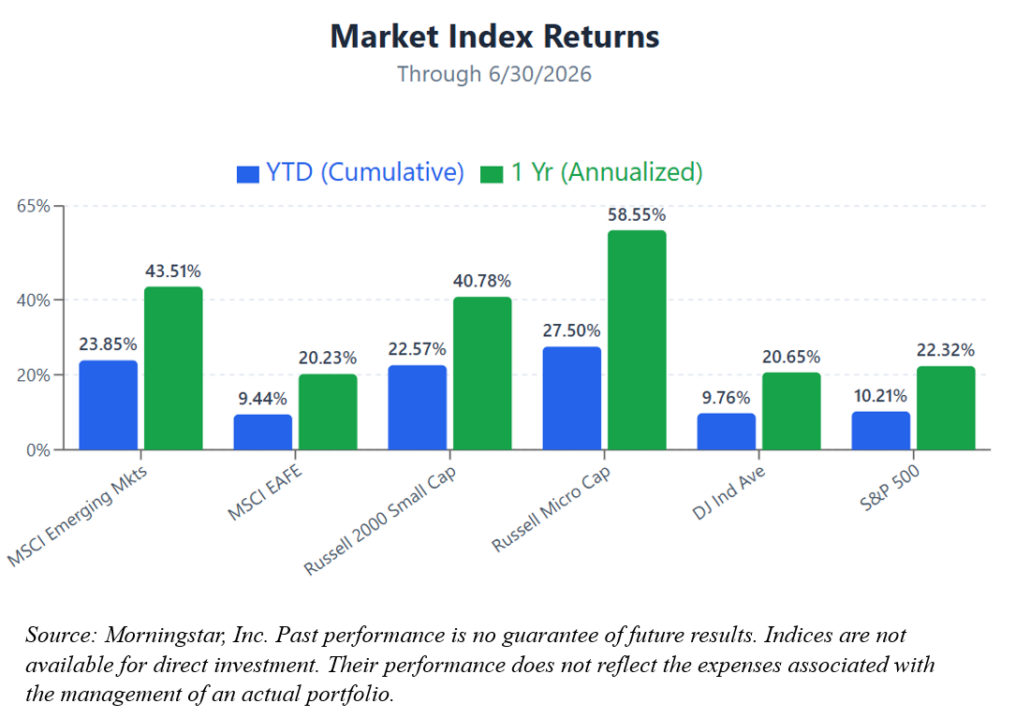
The diversification-doesn’t-work-anymore crowd tends to re-emerge whenever Blue Chip U.S. stocks outperform all other asset classes for several years, as they did from 2023-24. That’s why it’s so important in those time periods to keep in mind market environments like we’ve seen recently, when diversifying across asset classes and investment styles have historically helped provide periods of improved returns over just being in an S&P 500 index fund.
One of the most common cognitive biases that trips up investors is recency bias. This is the human tendency to take current events and project them into the future indefinitely. Recency bias is why so many investors feel overly confident in bull markets and overly pessimistic in bear markets; the emotional assumption is that whatever has been happening in the market recently is just going to keep on going.
That’s not the way the world works, of course, which is why we always advocate for a healthy dose of disciplined caution in both good and bad markets. Staying true to your long-term investment strategy as detailed in your Investment Policy Statement is one way to help combat recency bias.
But there is another common variant of recency bias that we also see many investors struggle with; the belief (or maybe just a feeling) that the myriad problems that plague us today are unsolvable. Major problems can often feel this way because they are known entities, while the potential solutions to them are as yet still unknown. In our opinion, this is a more destructive version of recency bias, because it leads to a sense of cynicism that often borders on fatalism. That can lead investors to give up on investing because things look hopelessly bleak.
In that regard, several major technological breakthroughs that may hold solutions to major human problems caught our eye recently – all of which have hit the spotlight just during Second Quarter 2026:
- Researchers at the University of Illinois Urbana-Champaign have developed a process using 3D printers to create copper cooling plates that pull energy away from computer chips vastly more efficiently than anything currently on the market. These 3D printed chips have the potential to dramatically reduce a data center’s cooling energy usage from about 30% to about 1.1% of its total power usage.
- Google invested $468 million in Proxima Fusion, a German company working to build the world’s first nuclear fusion reactor. Unlike nuclear fission reactors that run the risk of a radioactive meltdown (like Chernobyl), nuclear fusion reactors don’t run the risk of an uncontrolled nuclear reaction and are potential game changers for the global energy supply.
- U.S. petroleum engineers announced the development of a new drilling technology that will potentially unlock tens of billions of barrels of oil in undersea fields in U.S. coastal waters that were long believed to be impossible to access.
It’s well to remember, and appreciate, that people are adaptable and resourceful. They don’t remain static in the face of large-scale problems; they react to circumstances and get to work on a solution. These solutions are often the result of thousands or even millions of people working simultaneously, behind the scenes. They don’t get nearly as much attention in the media as the problems themselves do, which is why these groundbreaking solutions often seem to come out of the blue. It’s all a testament to human ingenuity, the most impactful and least appreciated change agent that exists.
It’s tempting to take stock (forgive the pun) of the recent market run-up and come to the conclusion that there’s no more room left to run in this current bull market. That conclusion is even easier to reach if you spend any time listening to the pundits on the financial news channels and their endless speculation about whether the market is overvalued or undervalued. No surprise that many of the talking heads are coming down on the “overvalued” side after the recent runup in stocks and are advocating for investors to pull back from equities before a downturn commences.
But are they right? Do they have some crystal ball the rest of us don’t possess? The historical record shows, repeatedly, that they do not. Market timers, no matter how credentialed, have not demonstrated a reliable ability to predict any more than anyone else about where the market is headed in the near term. Looking back at history, we see countless examples of bull markets that ran for months and years beyond what the conventional wisdom believed possible:
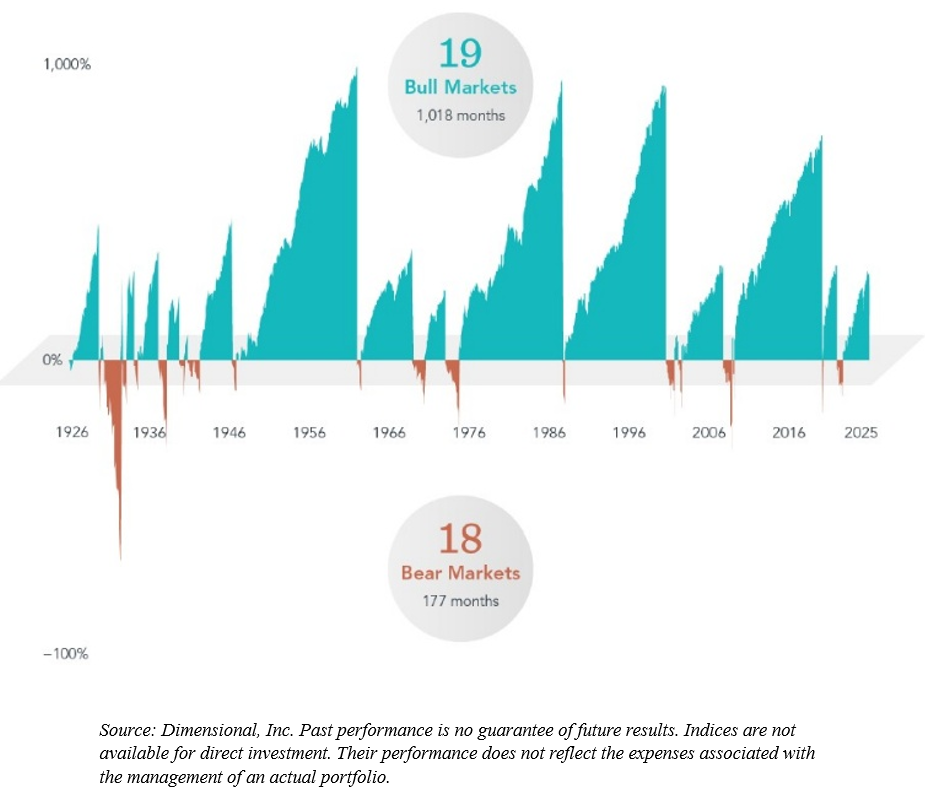
It’s our opinion is that the market is generally fairly valued – by which we mean that stock prices generally reflect all publicly known information at all times. Whether stocks are over- or under-valued at present will likely only be known in light of future events that are inherently unknowable and unpredictable. Any information that isn’t already public can’t be traded upon, at least not legally. For long-term investors, it’s generally helpful to keep the focus on the long-term upward trend of the stock market and let the short-term, short-lived declines come and go as they will.
Historical performance results for investment indices, benchmarks, and/or categories have been provided for general informational/comparison purposes only and generally do not reflect the deduction of transaction and/or custodial charges, the deduction of an investment management fee, nor the impact of taxes, the incurrence of which would have the effect of decreasing historical performance results. It should not be assumed that your account holdings correspond directly to any comparative indices or categories.
Diversification does not ensure a profit or protect against loss, and different asset classes may experience extended periods of underperformance.
Ready to Talk About Your Financial Strategy?
Periods of volatility can create uncertainty, but they also offer an opportunity to revisit your long‑term goals and ensure your plan remains aligned with your needs. If you’d like to discuss how these market insights apply to your personal financial situation, or if you’re considering adjustments to your investment strategy, our team is here to help.
HTB Wealth Advisors partners with clients to build evidence‑based, disciplined wealth plans designed to weather market shifts and support long‑term success.
Ready to take the next step? Start with a no-cost investment assessment. It’s an easy way to review your current portfolio, identify opportunities, and see how personalized planning can help you achieve your goals.